
AI Employees: Meet the Digital Workforce Changing How Businesses Get Work Done
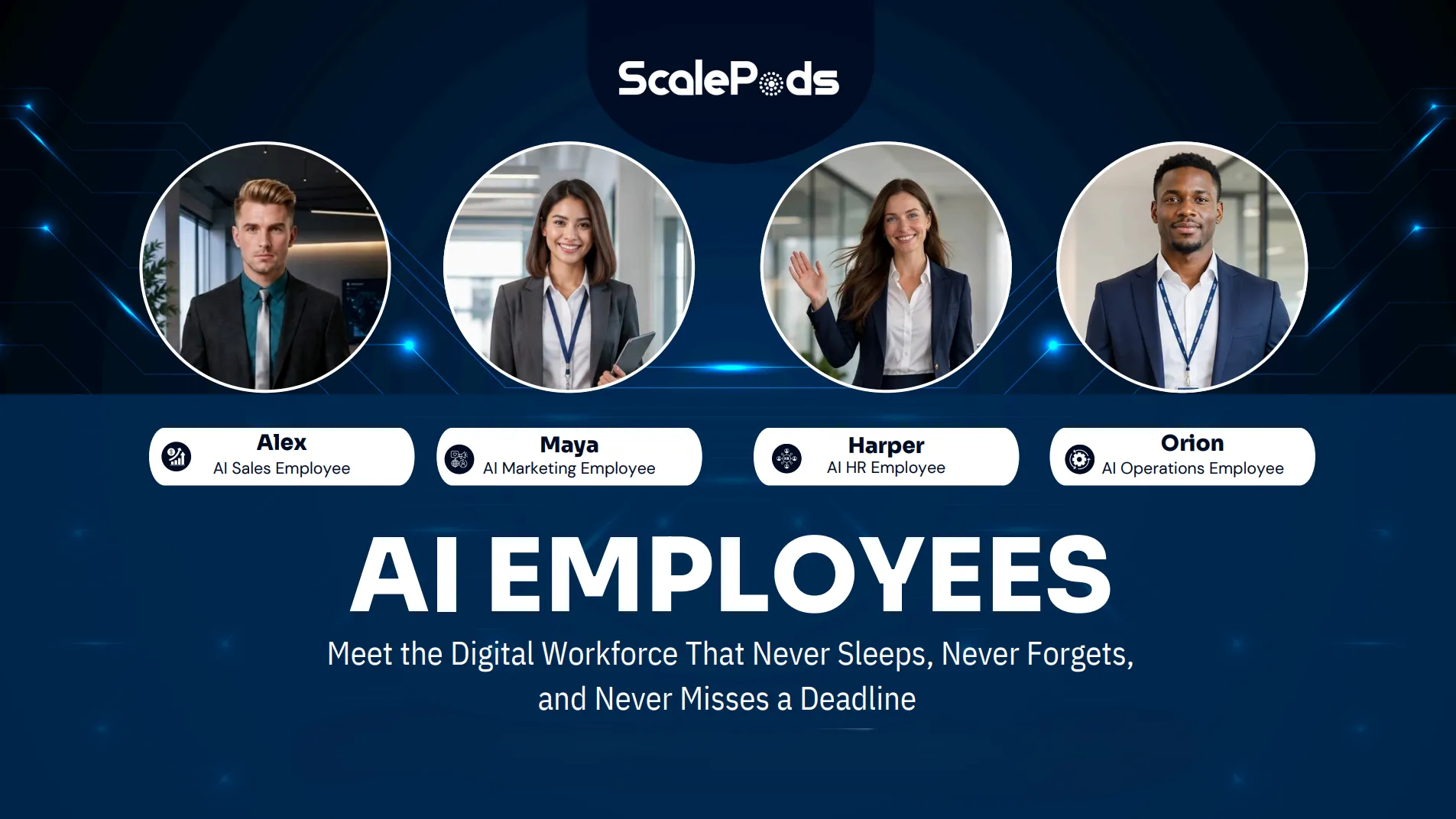
A practical look at how AI employees work, and how four of them — Alex, Maya, Harper, and Orion — cover sales, marketing, HR, and operations without ever clocking out.
Introduction
Every business grows the same way: work piles up, so you hire. A rep to chase more leads. A coordinator to keep the CRM current. A marketer to keep content flowing. It works, until it doesn't; headcount grows faster than output, and your busiest people end up spending their days on tasks that don't actually need a human brain.
That's the gap AI employees are built to close. Not another dashboard. Not another app your team has to remember to check. A digital team member that logs in before you do, works through its responsibilities independently, and hands off decisions to a human only when a human judgment call is actually needed.
The Hidden Cost of Repetitive Work
Every hour spent on data entry, status updates, or routine follow-up is an hour not spent on strategy, creativity, or closing deals. Repetitive work rarely shows up as its own line on a budget, it just quietly slows everything else down. Research from McKinsey backs this up: the large majority of workers spend a meaningful share of their week on tasks that are partially or fully automatable. We break down what that hidden cost looks like in practice in our complete guide to sales automation.
From Software, to Automation, to AI Employees
Software gave teams tools to do their jobs faster. Automation removed some of the manual steps from a process. AI employees go a step further — they don't just support the work, they own it, start to finish, and get better the longer they work with you.
An AI employee is a digital team member built to own a full role, not just a single task. It's the difference between a tool that helps you send an email and a colleague who plans, writes, sends, and reports on the whole campaign.
Meet the AI Employees
At ScalePods, our AI workforce is built around four roles: sales, marketing, HR, and operations. Each one is a distinct AI employee with its own daily routine and its own set of capabilities. Here's what a day looks like for each of them.
Alex — AI Sales Employee
By the time your sales team logs in, Alex has already found new prospects, qualified leads, sent personalized outreach, followed up on yesterday's conversations, updated the CRM, and prioritized today's opportunities. He never forgets a follow-up and never asks for another manual CRM update.
Alex's day, roughly:
Core capabilities: lead generation, multi-channel outreach, lead nurturing, CRM updates, lead scoring, sales intelligence, and dashboards.
Your salespeople should be building relationships while Alex handles everything else. For a deeper look at rolling this out, see our step-by-step guide to sales workflow automation and this SDR-focused automation guide for prospecting and cold outreach specifically.

Maya — AI Marketing Employee
Before your marketing team starts work, Maya has already reviewed yesterday's campaign performance, found trending topics, planned today's content, designed social creatives, scheduled posts, flagged underperforming campaigns, and suggested improvements.
Maya's daily loop: Research → Strategy → Content → Publishing → Optimization → Reporting — a closed loop that runs every day, whether your team is online or not.
Core capabilities: business understanding, competitor research, content generation, creative generation, publishing, repurposing, performance analytics, and AI marketing assistance.
Marketing shouldn't stop when your team goes home. For a broader look at how AI is reshaping this function, see our complete guide to marketing automation for 2026.

Harper — AI HR Employee
Before HR has had its first coffee, Harper has already reviewed every application, ranked candidates, scheduled interviews, prepared interview summaries, generated offer letters, and started onboarding.
Harper's daily routine: Applications → Resume Screening → Candidate Ranking → Interview Scheduling → Hiring → Onboarding.
Core capabilities: resume analysis, candidate intelligence, interview management, offer generation, onboarding, HR analytics, and AI HR assistance.
Harper manages the process. Your HR team manages the people. For the full picture, read our complete guide to HR automation for 2026.

Orion — AI Operations Employee
While everyone else is busy, Orion is quietly reading invoices, comparing purchase orders, checking compliance, finding discrepancies, updating dashboards, and preparing executive reports. He notices problems before people do.
Orion's daily routine: ERP → Document Validation → Compliance → Risk Detection → Approvals → Dashboards — a continuous loop, not a one-way process.
Core capabilities: purchase audits, sales audits, compliance, quality validation, operations dashboards, and an AI operations assistant.
Operations shouldn't be reactive — Orion keeps the business running. This kind of always-on monitoring is part of a bigger shift we cover in 5 ways AI assistants are transforming operations and beyond bots: real business impact from AI integration.

How the Team Works Together
Alex, Maya, Harper, and Orion don't work in silos but each one feeds information to the others as it's generated. A lead Alex qualifies can inform the content Maya plans. A hire Harper onboards shows up in Orion's headcount reporting. Every AI employee draws from the same underlying business data, so no department is working off stale or partial information.
The practical result: instead of four disconnected tools, your team sees one consistent view of sales, marketing, HR, and operations — and leadership gets a single, current picture of the business without waiting on four separate status updates.
Picture tomorrow morning: Alex has already found new leads, Maya has already launched today's campaign, Harper has already shortlisted candidates, and Orion has already verified yesterday's transactions. Your human team walks in and starts working on decisions instead of administration.

Why This Matters Now
The businesses adopting AI employees today aren't just moving faster but they're operating with a level of consistency and coverage no human team working solo can match alone. It's part of a broader shift in how companies structure their operations; we go deeper on that trend in the future of workflows: why AI automation is the standard and look at how fast-growing companies are using it specifically in scaling smarter: how automation helps startups.
Sooner or later, most businesses will have some form of AI workforce. The only real question is when yours starts and which role it takes on first.
The Takeaway
The businesses that win over the next decade won't have the biggest teams. They'll have the smartest ones — teams where humans bring creativity, empathy, and judgment, while AI employees handle the repetitive execution that slows businesses down today.
You're not buying software. You're building a workforce.