
ScalePods
Back To All Blogs
July 8, 2026Article

Marketing Automation: The Complete Guide for 2026

Marketing teams in 2026 manage more channels, higher acquisition costs, and more content demands than ever — with the same headcount. Learn how AI-powered automation helps you launch campaigns faster, cut wasted spend, and scale results without scaling headcount.

Marketing Automation: The Complete Guide for 2026

Introduction

Marketing teams in 2026 manage more channels, higher acquisition costs, and more extensive content demands than ever with the same headcount. In 2026, most fast-growing teams use AI-powered automation to launch campaigns faster and cut wasted spend. This guide shows exactly how you can implement AI in your marketing workflows, using a step-by-step implementation plan.

The Building Blocks of Marketing Automation

The foundation of modern marketing operations relies on key building blocks that transition traditional processes into automated, self-sustaining workflows.

FOUNDATION 01

What is Marketing Automation?

Marketing automation is software-driven technology that executes, tracks, and optimizes repetitive marketing tasks like email sends, lead scoring, and campaign reporting — without requiring manual action for every step. It replaces manual execution with rule-based or AI-driven workflows that run continuously in the background.

FOUNDATION 02

Key Capabilities of Marketing Automation

Marketing automation typically includes: • Trigger-based email and SMS sequences • Lead scoring and qualification logic • Multi-channel campaign scheduling • Behavioral tracking across the customer journey • Automated reporting and attribution

FOUNDATION 03

How it Works: Triggers, Workflows, & Data

It runs on three components working together: triggers (an action like a form submission), workflows (the automated response that follows), and data (the customer context that personalizes each step). Someone fills out a form, and within seconds a workflow scores the lead, drops them into the right nurture sequence, and notifies sales — no human touched any of it.

FOUNDATION 04

Why Marketing Automation Matters in 2026

Marketing automation matters even more in 2026 because buyer expectations have shifted toward real-time, personalized engagement — and AI has made that achievable at scale. Teams still working manually aren't just slower; they're structurally unable to match automated competitors' response speed, and it shows up directly in conversion rates and acquisition cost.

The Evolution of Marketing Automation

Two decades of change moved marketing automation from basic scheduling to predictive AI and now, to systems that plan and run campaigns on their own.
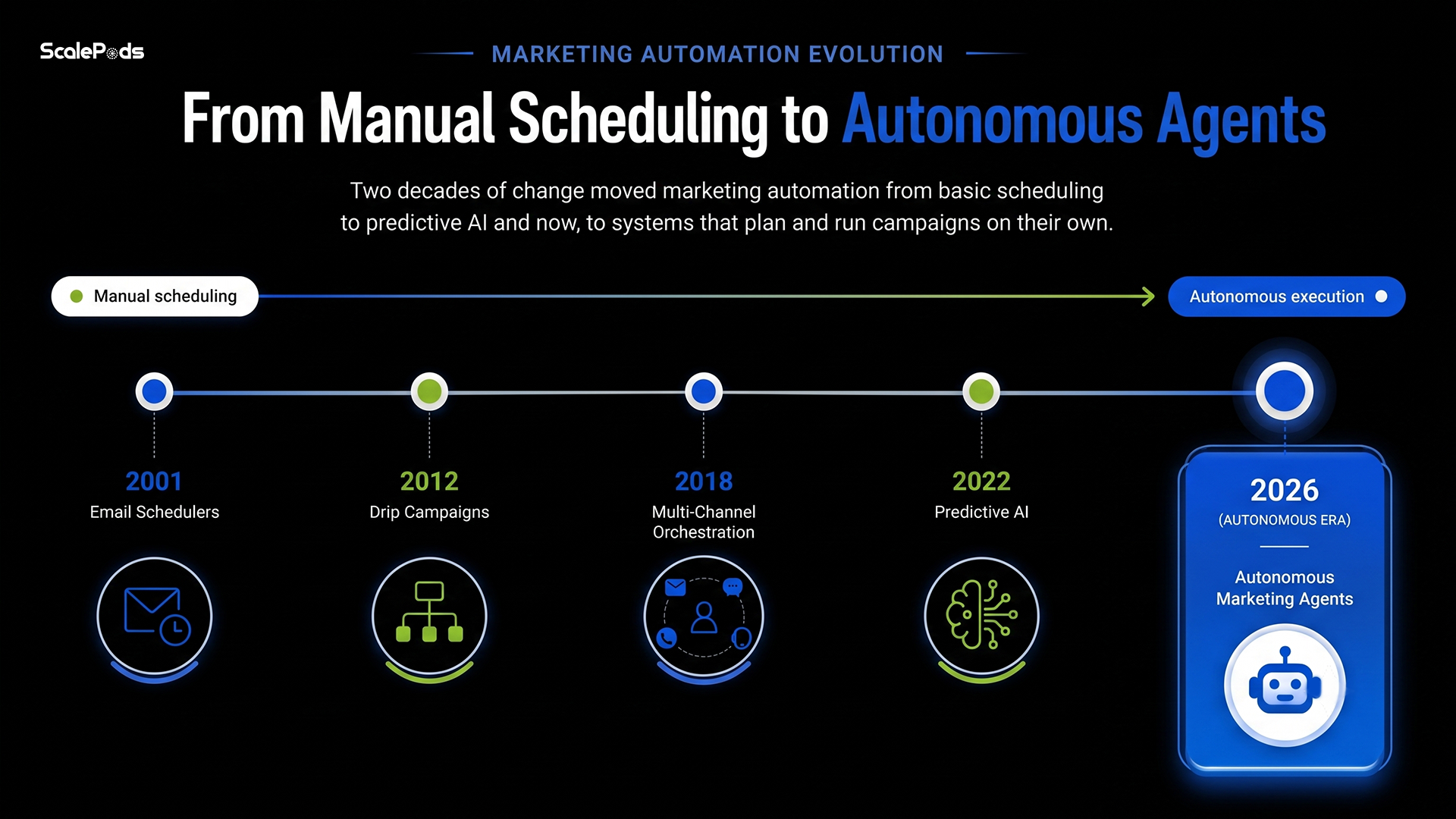
The Evolution of Marketing Automation

Benefits of Marketing Automation

Most teams don't adopt marketing automation for one big reason — it's the accumulation of small ones that adds up over a few months. Hours come back. Leads get followed up with faster. Reporting stops being a Friday-afternoon scramble. None of it looks dramatic on its own, but together it changes what a marketing team is actually capable of.

Higher Marketing Efficiency: Automating repetitive execution — scheduling, list segmentation, reporting — gives marketers back hours every week that were previously spent on tasks with no strategic value.
Improved Lead Conversion: Automated lead scoring and instant follow-up mean prospects hear back while they're still engaged, and response speed is one of the strongest predictors of conversion.
Faster Campaign Execution: What used to take days to build, test, and launch across channels can be assembled once and deployed everywhere simultaneously.
Better Customer Engagement: Behavior-triggered messaging feels timely and relevant instead of generic, because it responds to what a customer actually did.
Reduced Operational Costs: Fewer manual hours per campaign means marketing operations can scale output without scaling headcount at the same rate.
Enhanced Marketing Analytics: Automation platforms capture every touchpoint automatically, producing a complete data set instead of fragmented, manually-stitched-together reporting.
Improved ROI Measurement: With full-funnel tracking built into the workflow itself, marketers can attribute revenue back to specific campaigns with far more confidence than manual attribution allows.
10×
Faster Content Production
80%
Less Manual Coordination
40%
Team Efficiency Improved
MARKETING WORKFLOW SOLUTION →

ScalePods Marketing Landing Page

Learn how ScalePods automates lead capture, qualification, email campaigns, and behavior-triggered customer journeys.

12 Marketing Processes Every Business Should Automate

Not every task deserves automation — but these twelve consistently deliver the fastest return when you take them off manual execution.

01

Lead Capture

Automatically pull form submissions, chat interactions, and landing page conversions directly into your CRM.

02

Lead Qualification

Score leads automatically based on firmographic fit and behavioral signals to prioritize high-value prospects.

03

Email Marketing

Build automated welcome series, re-engagement, and announcements with behavioral send-time optimization.

04

Lead Nurturing

Move prospects through the funnel automatically with relevant content adjusted to their active engagement.

05

Customer Segmentation

Group contacts dynamically based on real-time behavior and attributes instead of static lists.

06

Social Media Publishing

Schedule and publish across every social channel from one centralized, automated workflow.

07

Content Distribution

Automatically syndicate and deliver new content to the right segments based on topic and interest profile.

08

Ad Campaign Management

Automate bid adjustments, budget pacing, and audience targeting to optimize ROI in real time.

09

Campaign Reporting

Generate multi-channel performance reports automatically, eliminating manual weekly collation.

10

Customer Journey Tracking

Map every single touchpoint across web, email, and sales interactions to trace paths to conversion.

11

Marketing Attribution

Attribute revenue back to specific campaigns across multi-touch buyer paths with absolute accuracy.

12

Performance Analytics

Continuously surface active channel trends and ROI insights to make data-driven marketing investments.

MARKETING RESOURCES & DATASHEETS →

List ScalePods Marketing Datasheets

Download marketing integration playbooks, campaign setup templates, and advanced marketing attribution flowcharts.

Marketing Automation Use Cases

Marketing automation looks different depending on the business model, team size, and channels in play — but these five use cases represent where it delivers the most consistent ROI.
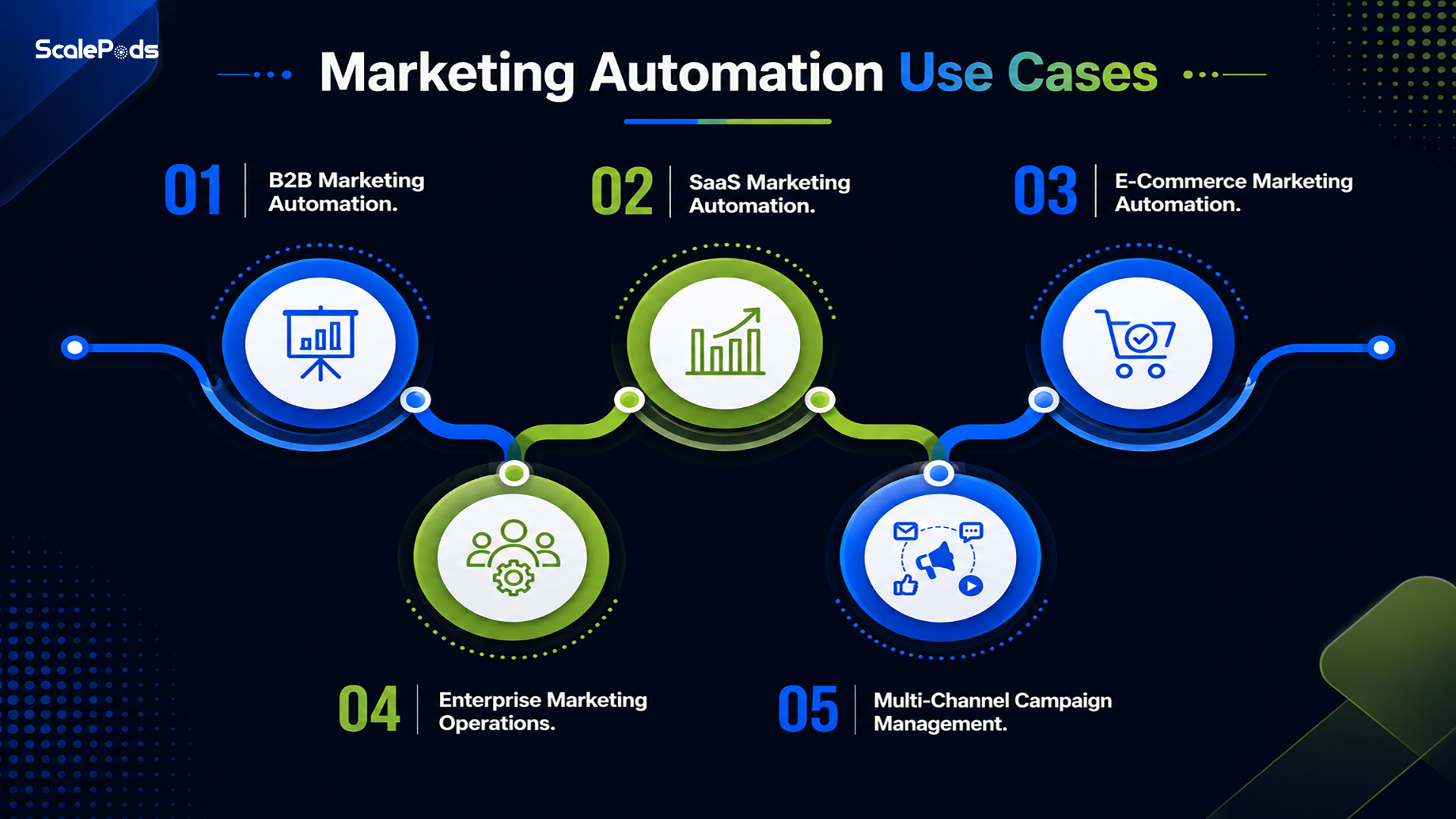
Marketing Automation Use Cases
B2B Marketing Automation
B2B buying cycles are long and involve multiple stakeholders. Automation keeps every lead nurtured consistently across a sales cycle that can stretch for months, without anyone falling through the cracks.
SaaS Marketing Automation
SaaS teams use automation to run product-qualified-lead workflows, trigger in-app onboarding sequences, and flag expansion or churn-risk signals the moment usage data indicates them.
E-Commerce Automation
From abandoned-cart recovery to post-purchase upsell sequences, automation lets e-commerce brands respond to shopping behavior in real time, at a volume no manual team could match.
Enterprise Marketing Ops
At enterprise scale, automation is less about single campaigns and more about coordinating dozens of teams, regions, and brands on a shared operational system without losing consistency.
Multi-Channel Campaigns
Automation platforms let a single campaign brief translate into coordinated, channel-appropriate execution across email, social, paid, and SMS without manually rebuilding it five times.

How AI is Transforming Marketing Automation in 2026

AI didn't just speed up marketing automation — it changed what automation is capable of deciding on its own.

AI Content Creation
AI generates first-draft copy, subject lines, and creative variations at a volume that lets teams test more and iterate faster.
Predictive Lead Scoring
Instead of static point-based rules, AI models learn from historical conversion data to predict which leads are actually likely to close.
AI Campaign Optimization
AI systems adjust send times, channel mix, and creative selection mid-campaign based on real-time performance data.
Behavior Prediction
By analyzing patterns across the full customer journey, AI can flag purchase intent, churn risk, or expansion opportunity before they'd be obvious.
Autonomous Marketing Agents
The newest generation of tools can plan and execute entire campaign workflows with minimal setup — defining audience, drafting creative, and scheduling.
AI-Driven Personalization
AI enables true 1:1 personalization at scale — dynamically adjusting messaging, offers, and content for each individual based on behavior.

How to Implement Marketing Automation Successfully

The platform matters less than the plan. Here's the sequence that actually gets automation live without disrupting the campaigns already in motion.

STEP 01

1. Define Marketing Objectives

Start with what success looks like — faster lead response, higher conversion rate, lower cost-per-lead — before evaluating a single tool.

STEP 02

2. Map Customer Journeys

Document the actual path customers take today, touchpoint by touchpoint, including the manual steps currently holding it together.

STEP 03

3. Identify Automation Opportunities

Prioritize high-frequency, low-judgment tasks first, and leave genuinely judgment-heavy decisions with a human in the loop — at least initially.

STEP 04

4. Integrate Data Sources

Connect your CRM, website analytics, and ad platforms before building workflows, so every automated decision is working from a complete picture of the customer.

STEP 05

5. Measure Performance

Set a review cadence from day one — weekly in the first month, then monthly — to catch workflows that aren't performing before they run unchecked for a quarter.

Common Marketing Automation Challenges

Every team that adopts automation eventually hits the same wall of problems — some show up in a dashboard, others don't show up until a customer notices first.

Tool Fragmentation78%
78% report siloed marketing tech
Attribution Accuracy Gap68%
68% don't achieve accurate ROI measurement, despite feeling confident
AI Trust Erosion62%
62% trust content less once they know it's AI-generated
Poor Data Quality45%
45% of marketing data is incomplete or outdated
Lack of Strategy20%
20% cite data-driven strategy as a top challenge

How to Choose the Right Marketing Automation Platform

Most platform decisions get made in a demo, under time pressure, based on whichever sales team told the best story. That's how teams end up locked into an eighteen-month contract with a tool that can't actually do what they need.

CONCEPT 01

Essential Features

The floor is simple enough. A real marketing automation platform needs five things at minimum: email and multi-channel campaign building, lead scoring, CRM integration, and reporting. • Email and multi-channel campaign building • Lead scoring and qualification • CRM integration • Reporting and analytics If a platform doesn't clear that bar, it's a point solution, not marketing automation software; no matter what the pricing page calls it.

CONCEPT 02

AI Capabilities

This is where it gets murkier. Every vendor says "AI-powered" now. Few of them mean predictive lead scoring, content generation that's actually useful, or campaign optimization that runs without someone babysitting it. The honest way to check: ask what happens if you turn the AI features off. If the platform barely changes, the AI was never doing much work.

CONCEPT 03

Multi-Channel Support

Then there's the unglamorous stuff that ends up mattering most a year in. Whether your channels - email, SMS, social, paid - are natively supported, or held together with third-party connectors that add a half-second of lag and one more thing that can break silently.

CONCEPT 04

Reporting & Analytics

Whether the dashboard tells you something in real time, or whether someone's still exporting a CSV every Monday to make sense of it. Real-time, customizable reporting with attribution built in is the difference between a tool that informs decisions and one that just documents them after the fact.

Marketing Automation Trends for 2026

The platforms, tools, and approaches that define leading marketing operations in 2026 — and where the industry is heading.

How ScalePods Helps Businesses Automate Marketing Operations

Everything covered in this guide, running inside one platform.

PREPARING EXPERIENCE...
Campaign Management
Plan, schedule, and launch every campaign from one workspace.
Content Automation
First-draft copy and channel formatting, generated automatically.
Lead Generation Workflows
Leads captured, scored, and routed in real time.
Multi-Channel Execution
One campaign brief, deployed everywhere at once.
AI-Powered Operations
Send times and targeting optimized automatically.
Analytics & Insights
Every channel reporting into one live dashboard.
ScalePods

Build a sales system that works even when your team is offline

Smarter workflows. Better conversations.

FAQs About Marketing Automation

Marketing automation is software that executes and optimizes repetitive marketing tasks like emails, lead scoring, and reporting — using triggers and workflows instead of manual action. It works by combining a trigger (a customer action), a workflow (the automated response), and data (customer information that personalizes it).
Back To All Blogs