ScalePods
July 27, 2026Article

How to Implement Sales Workflow Automation (Step-by-Step)

A 4-step framework for rolling out sales workflow automation without breaking your process — plus the 5 most common mistakes to avoid.

How to Implement Sales Workflow Automation (Step-by-Step)

Introduction: Why Sales Workflows Are Evolving

Sales teams have followed a fairly consistent process since the early days of selling: cold outreach, gauging client interest, and driving conversions. While there have been innovations along the way, most have come in the form of CRMs. These tools have made management easier, but they haven’t reduced the actual workload for sales teams. In fact, CRMs have often contributed to an increase in administrative tasks rather than easing the burden. Salesforce's State of Sales research shows that the average sales rep spends only 40% of the week on real selling. The other 60% is lost to admin work like data entry, research, and chasing follow-ups.

With the introduction of AI, this is going to change drastically. Sales workflows are bound to see real innovation, and drive a higher business share. Gartner forecasts expect worldwide AI spending to reach about $2.5 trillion in 2026 and project the CRM sales software market to hit $28.7 billion in 2025, growing strongly after that. This means if you are not breaking the mold of how your sales team functions - your competitor might just get the edge over you!

This blog will show you what sales workflow automation is, why 2026 is a turning point, and how a system like ScalePods can help you build a fast, reliable sales engine without drowning your team in tools. The goal is not to replace humans. The goal is to remove busywork so your team can spend most of their energy on conversations that actually close deals.

What is Sales Workflow Automation?
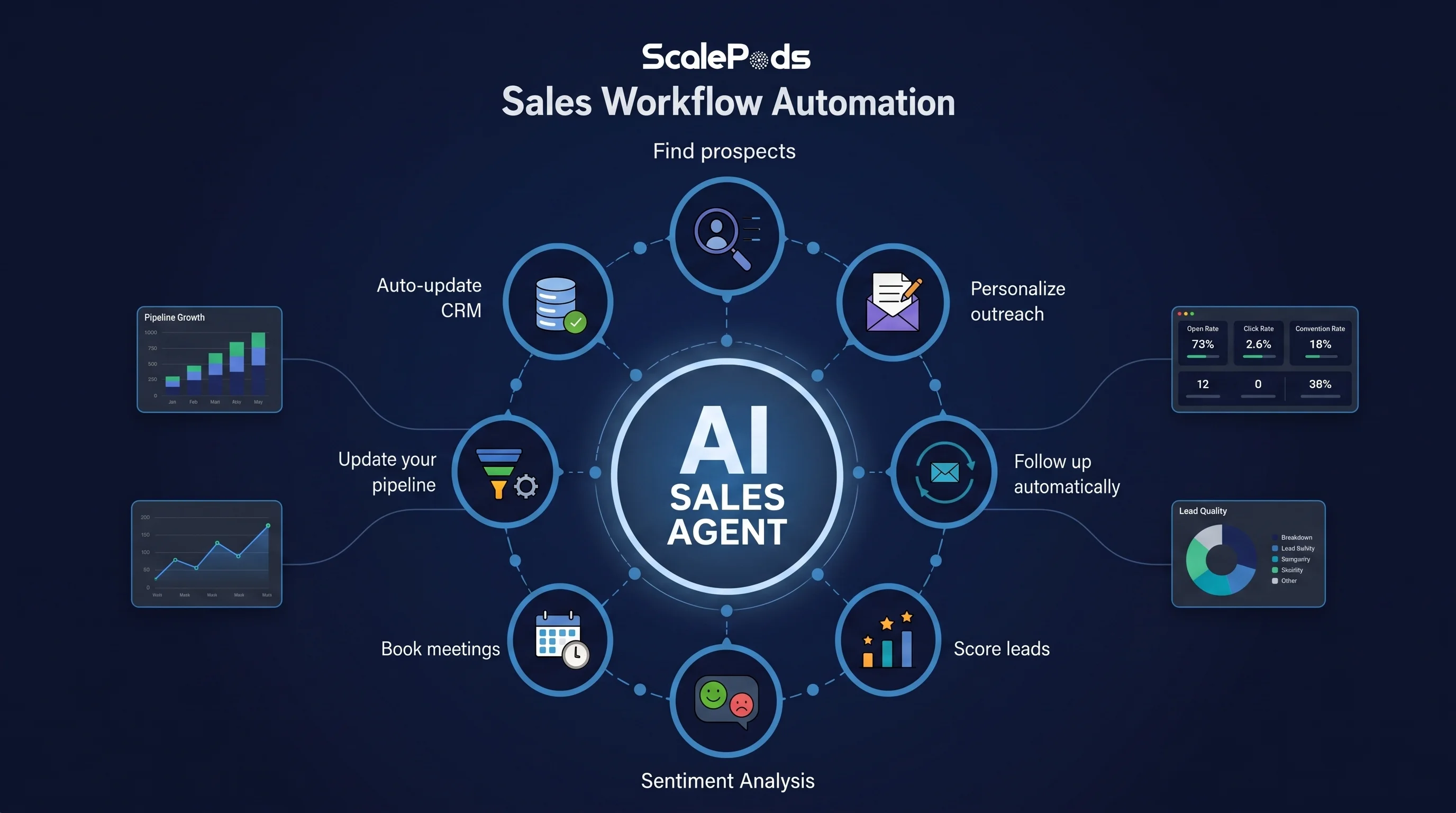
Traditional vs Modern AI-Powered Sales Automation

Sales workflow automation means using software and AI to handle repetitive, rule-based tasks in your sales process so that humans can spend more time driving strategic conversations. Instead of a rep updating the CRM after every call, a system can log it. Instead of a rep typing every follow-up email from scratch, a system can draft and send it according to a smart plan.

Modern automation has evolved to cover the entire customer journey, making processes more seamless and efficient than ever before. Instead of handling isolated tasks, today’s systems manage multiple stages in a connected, intelligent flow:

Identifying and targeting the right prospects
Sending personalised outreach at scale
Running consistent and timely follow-up sequences
Scoring and prioritising leads based on intent
Booking meetings without manual back-and-forth
Keeping the sales pipeline continuously updated

This marks a significant shift from how automation worked in the past. Earlier systems were limited to executing predefined, rule-based actions, which made them rigid and reactive. In contrast, modern AI-powered systems bring a new level of intelligence by learning patterns from real interactions, adapting to changing buyer behavior, and making increasingly accurate recommendations over time.

Why 2026 is a Turning Point for Sales Automation

Gartner predicts that AI agents will outnumber human sellers by 10 to 1 by 2028. They also expect about 40% of enterprise apps to include task-specific AI agents by the end of 2026, up from less than 5% in 2025. This means sales tools are quickly being rebuilt around automation by default, not as an optional add-on.

Understanding what modern automation can do is one thing and actually implementing it effectively is another.

This is where platforms like ScalePods come in. Instead of stitching together multiple tools or relying on rigid workflows, ScalePods helps businesses deploy intelligent, end-to-end automation systems that are designed to learn, adapt, and scale with real-world usage.

Modern Sales Workflow and What Automation Delivers
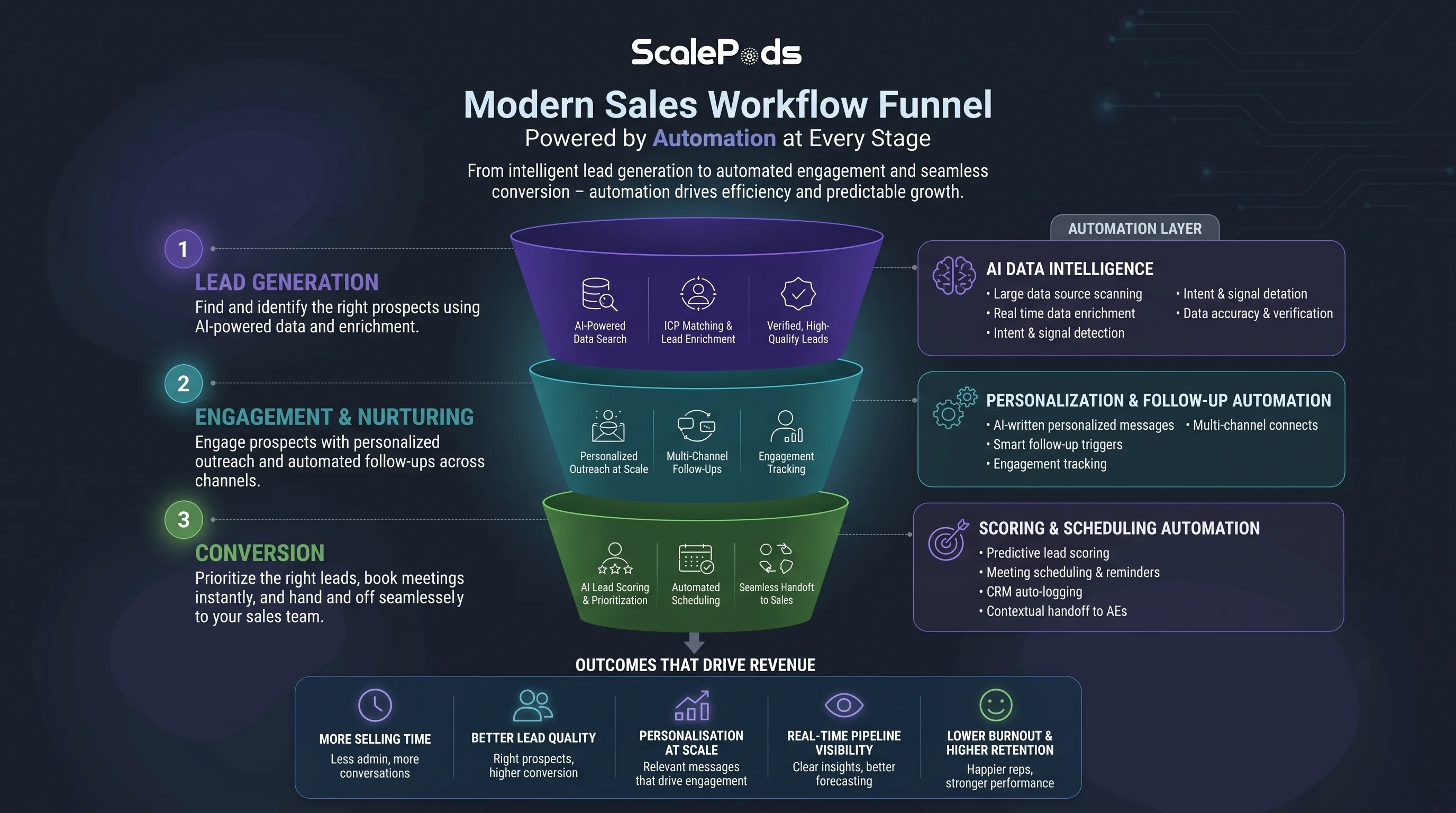
The 5 Stages of Modern Sales Workflow Automation

Most B2B sales teams follow a similar five-stage workflow. What has changed is how these stages are executed using automation and AI. When implemented correctly, sales workflow automation improves efficiency, lead quality, and revenue predictability across the entire funnel.

STAGE 01

Prospect Research and Lead Enrichment

In traditional workflows, sales reps spend 4 to 8 hours a day identifying prospects, verifying contact details, and assessing fit. With automation, AI tools match your ideal customer profile based on role, industry, company size, and tech stack to generate verified lead lists in minutes.

STAGE 02

Personalised Outreach at Scale

Generic outreach no longer drives results. AI tools analyse signals such as LinkedIn activity, company updates, and job changes to generate tailored outreach messages for each prospect.

STAGE 03

Follow-Up Automation and Lead Nurturing

Inconsistent follow-up is one of the main reasons deals are lost. Automation enables structured follow-up sequences across email, LinkedIn, and messaging platforms based on time delays or user behaviour.

STAGE 04

AI Lead Scoring and Pipeline Prioritisation

AI-based lead scoring evaluates engagement signals, firmographic data, and historical performance to rank leads based on conversion probability.

STAGE 05

Meeting Scheduling and Sales Handoff

Automated scheduling allows prospects to book meetings instantly. The system logs interactions, sends reminders, and shares context with account executives before the call.

Benefits of Sales Workflow Automation

When these stages are connected through automation, the benefits extend across the entire sales process:

Increased selling time by reducing administrative work
Improved lead quality and more accurate forecasting
Personalised communication at scale
Real-time visibility into pipeline performance
Reduced burnout and better team productivity

Sales workflow automation does not just optimise individual steps. It creates a structured, scalable system that improves efficiency, decision-making, and overall sales performance.

A Simple Framework to Implement Automation in 2026

The biggest mistake teams make is trying to automate everything at once or layering AI on top of a broken process. Companies must first redesign their workflows, and then apply AI, to see growth. A simpler, phased approach works best:

STEP 01

Audit Your Current Workflow

Map your existing sales process end to end. Identify lead sources, routing, drop-off points, and time spent on tasks like research, follow-ups, note-taking, and scheduling. Key Outcome: Clear visibility into bottlenecks and high-friction manual tasks.

STEP 02

Automate One High-Impact Workflow

Start with a single, high-leverage use case such as meeting scheduling, follow-up sequences, or lead scoring. Key Outcome: Quick wins that build internal confidence and momentum.

STEP 03

Layer the Automation Stack

Gradually introduce additional automation layers over 60 to 90 days, adding AI prospecting, CRM integration, personalised outreach, and reporting dashboards. Key Outcome: Transition from isolated automation to a fully connected sales system.

STEP 04

Define Human vs AI Roles

Clearly separate responsibilities: AI handles research, data entry, outreach drafts, follow-ups, scoring, and scheduling; humans focus on conversations, discovery, objections, and closing. Key Outcome: Higher productivity, better performance, and a scalable Human + AI sales model.

Common Mistakes to Avoid

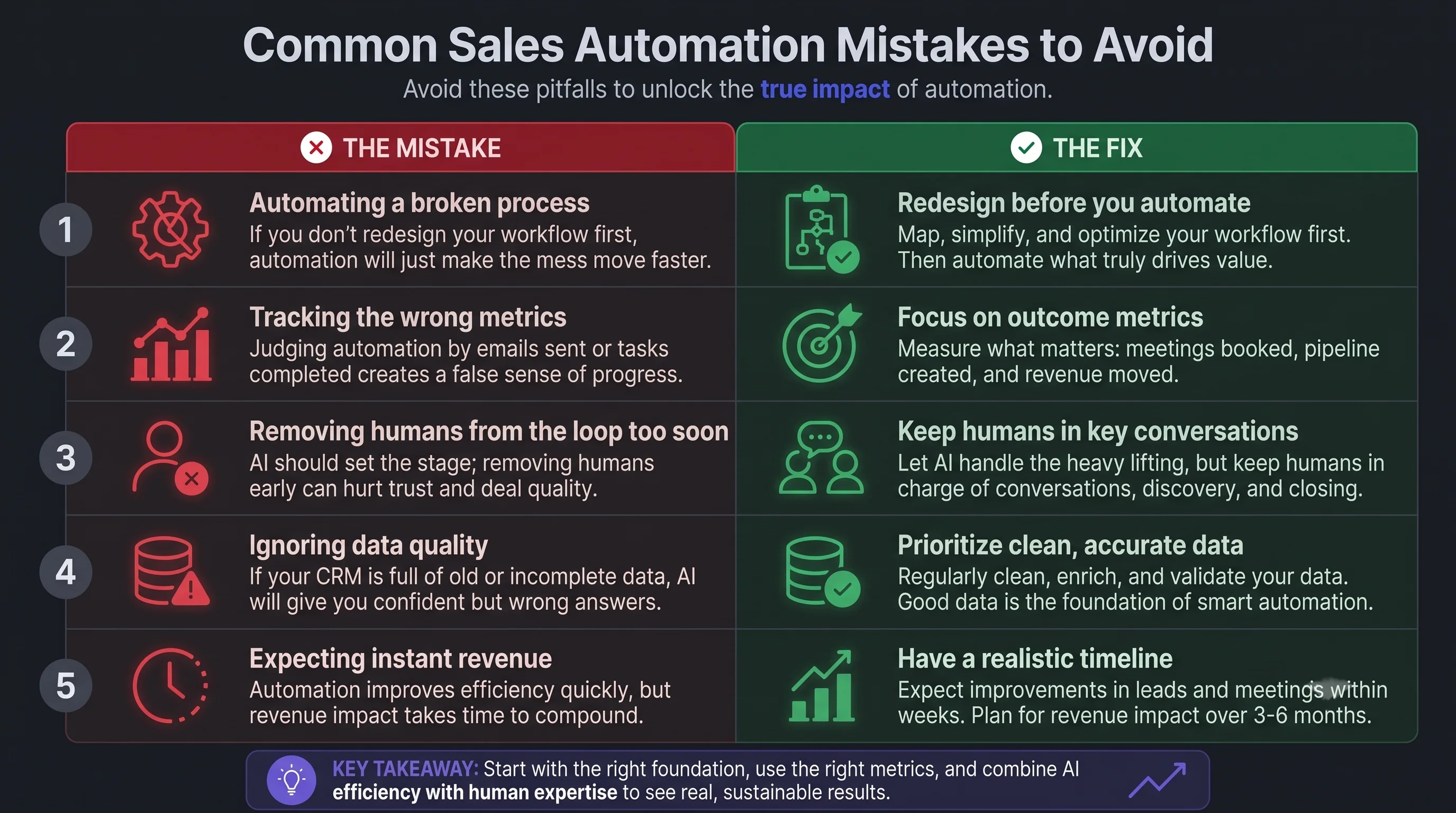
Common Mistakes to Avoid in Sales Automation

Research and real-world projects show the same handful of mistakes again and again. Avoiding these will save months of frustration:

MISTAKE 01

Automating a Broken Process

If you do not redesign your workflow first, automation will just make the mess move faster.

MISTAKE 02

Tracking the Wrong Metrics

Judge automation by meetings booked, pipeline created, and revenue moved — not by emails sent.

MISTAKE 03

Removing Humans from the Loop Too Soon

AI should set the stage; humans should still own key conversations.

MISTAKE 04

Ignoring Data Quality

If your CRM is full of old or incomplete data, AI will give you confident but wrong answers.

MISTAKE 05

Expecting Instant Revenue

Most mid-market teams see clear lead and meeting improvements in weeks, but revenue impact usually shows up over 3 to 6 months.

How ScalePods Fits Into This Picture

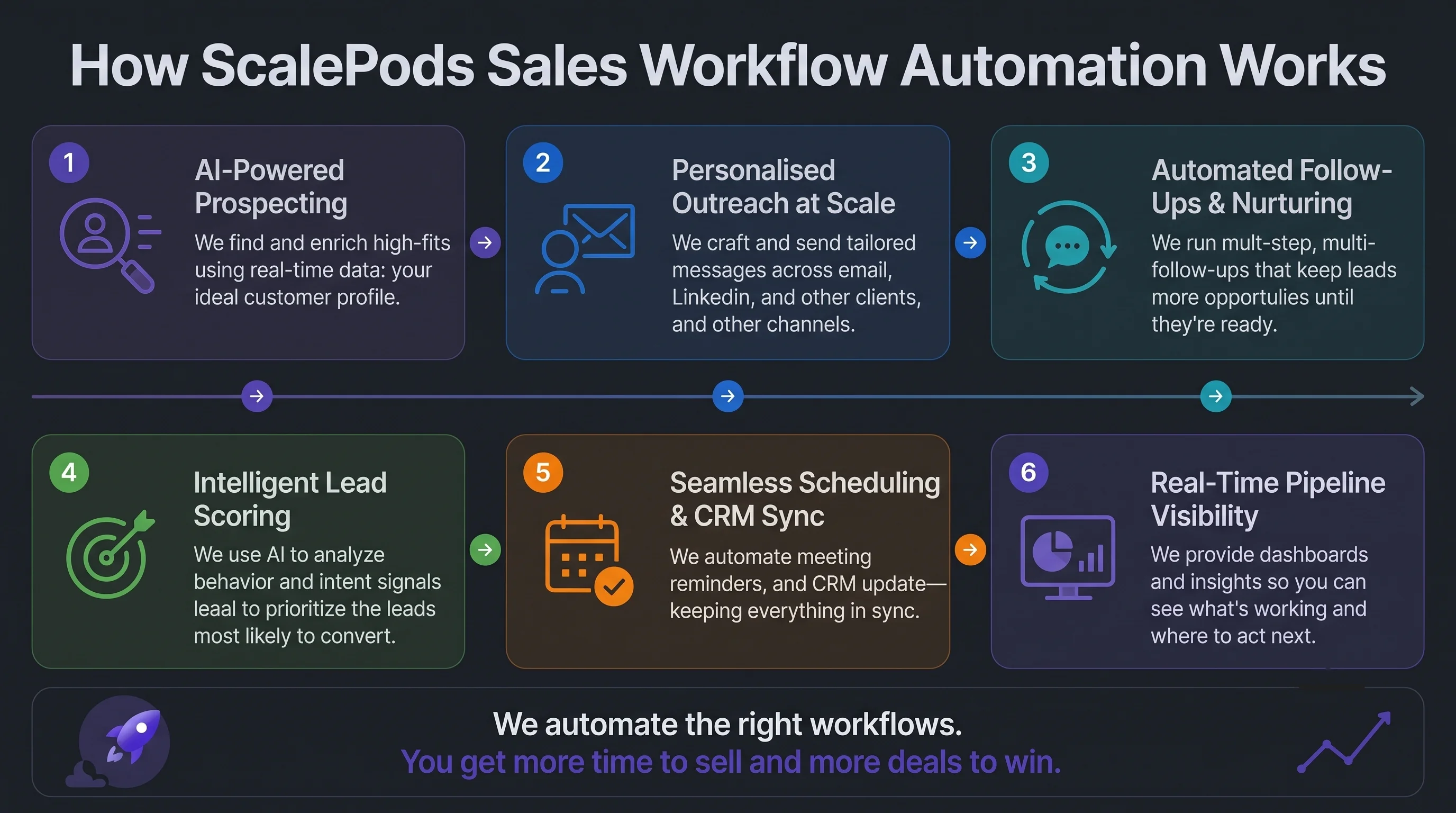
ScalePods AI Sales Execution Partner Architecture

Most sales teams are stuck in a loop of manual work, disconnected tools, and inconsistent execution. Leads come in, but follow-ups slip. Outreach happens, but not at scale. Data exists, but decisions still rely on guesswork.

ScalePods acts as your execution partner, designing and implementing a customised AI-powered sales workflow built around how your team actually operates. Instead of adding more tools, we integrate automation directly into your existing process so every stage of your sales funnel runs with clarity, consistency, and speed.

CAPABILITY 01

AI-Powered Prospecting

Identify and enrich high-fit leads automatically based on your ideal customer profile. Your team starts every day with ready-to-contact prospects instead of spending hours on research.

CAPABILITY 02

Personalised Outreach at Scale

Deliver tailored messaging across hundreds of prospects using real-time signals like company activity and role changes. Increase response rates without increasing workload.

CAPABILITY 03

Automated Follow-Ups and Nurturing

Ensure no lead goes cold. Multi-step, multi-channel follow-ups run automatically, keeping prospects engaged until they are ready to convert.

CAPABILITY 04

Intelligent Lead Scoring

Prioritise the leads most likely to close using behaviour and intent data. Your team focuses on opportunities that actually move revenue.

CAPABILITY 05

Seamless Scheduling and CRM Sync

Remove friction from booking meetings. Automate scheduling, reminders, and CRM updates so your pipeline stays clean and up to date without manual effort.

CAPABILITY 06

Real-Time Pipeline Visibility

Get a clear view of what is working and where deals are slowing down. Make faster, data-backed decisions without chasing updates from your team.

ScalePods

Build a sales system that works even when your team is offline

Smarter workflows. Better conversations.

FAQs About Sales Workflow Automation

No. The goal is not to replace humans but to remove low-value manual work so they can sell more. Industry research and analysis show that teams using AI and automation are more likely to hit quota because reps spend more time in real conversations and less time on data entry, research, and drafting emails. Automation is a co-pilot, not a replacement.