
5 Ways AI Assistants Are Transforming Operations (And How to Implement Them)
Every growing company reaches a critical tipping point where operational friction threatens to stall revenue growth. Discover 5 high-impact ways AI assistants are transforming enterprise operations.

Introduction: The Operational Tipping Point
Every growing company reaches a critical tipping point where operational friction threatens to stall revenue growth. Cross-tool context switching, manual data entry, fragmented project handoffs, and delayed customer communications devour executive focus and drive up operational expenditure.
Historically, solving operational sprawl meant adding headcount. Today, high-growth organizations are taking a different approach: deploying custom AI assistant ecosystems (AI Agent Pods) directly into their operational core.
Unlike standard conversational chatbots that simply answer static FAQs, modern operational AI assistants execute multi-step workflows, manage cross-platform data synchronization, and autonomously coordinate tasks across your tech stack.
Here are the 5 high-impact ways AI assistants are transforming enterprise operations, along with a practical roadmap for implementing them safely, securely, and scalably.
1. Always-On Autonomous Workflow Execution
Manual operational workflows are inherently bottlenecked by human working hours. When an urgent inquiry arrives at 10 PM or an operational anomaly occurs over the weekend, response delays disrupt customer trust and revenue pipeline momentum.
The Shift: From Reactive Support to Continuous Execution
AI assistants function as non-stop operational units. Operating on event-driven triggers and webhook listeners, they continuously monitor systems, route information, update records, and generate critical reports.
2. Context-Aware Cross-Tool Coordination
The average modern enterprise utilizes over 130 distinct SaaS applications. This tool fragmentation forces team members to spend up to 30% of their working day manually copying data between CRMs, project management systems, ERPs, and internal communication channels.
The Shift: AI as the Universal Operational Tissue
Rather than requiring employees to manually bridge data gaps, custom AI assistants integrate via APIs to read context from one system and take structured action in another.
👉 "True operational efficiency isn't achieved by replacing your existing software suite; it is achieved by deploying an intelligent orchestration layer that unites your entire tool ecosystem."
3. Real-Time Data Synthesis & Decision Acceleration
Making fast executive decisions usually requires waiting for analysts to pull reports, format dashboards, and clean data sets. By the time static reports arrive, market dynamics or customer needs have already shifted.
The Shift: Instant Actionable Intelligence
Operational AI assistants connect directly to data warehouses (BigQuery, Snowflake, PostgreSQL) and analytics tools. Using Natural Language Querying (NLQ), operational leaders can ask complex questions and receive immediate, actionable summaries:
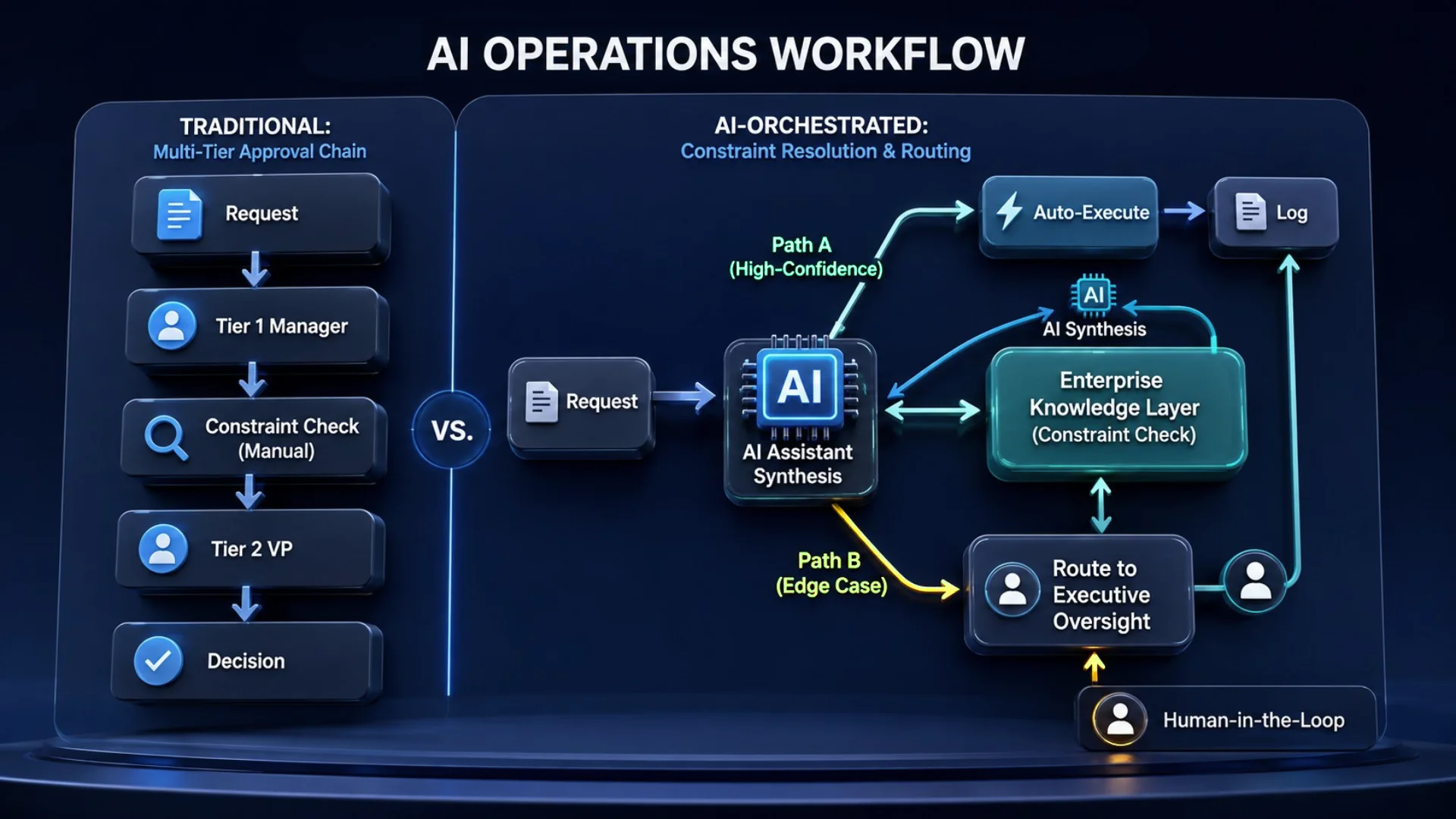
The visual decision tree below illustrates how human-in-the-loop checkpoints work alongside automated execution to route edge cases directly to executive oversight while high-confidence items auto-execute.
4. Scalable High-Touch Customer & Client Operations
Scaling operations traditionally means scaling support and client management headcount linearly with account growth. However, hiring rapidly often introduces quality control variance, training bottlenecks, and rising customer acquisition costs.
The Shift: Personalization at Scale
Custom AI assistants leverage your enterprise knowledge base (vector databases containing SOPs, historic support logs, product documentation, and communication guidelines) to interact with clients with high fidelity and brand alignment.
Key Implementation Capabilities
5. Scaling Capacity Without Inflating Headcount
The ultimate goal of operational leadership is driving revenue growth while keeping fixed overhead manageable. Every new hire carries hiring, onboarding, benefits, and management overhead costs.
The Shift: Decoupling Revenue from Headcount Growth
Integrating AI Agent Pods transforms fixed operational expenses into scalable, predictable infrastructure costs.
By delegating repetitive data handling, scheduling, triage, and reporting to autonomous AI assistants, existing human teams are freed to focus on high-leverage activities: strategic planning, client relationship building, and product innovation.
Evaluating Your Options: Off-the-Shelf SaaS vs. Custom AI Agent Pods
How to Implement AI Assistants in Your Operations: A 4-Step Blueprint
Scaling operations shouldn't require bloating your headcount or drowning your team in administrative overhead. Here is a practical roadmap for implementing custom AI assistants safely, securely, and scalably.
👉 Ready to Transform Your Operational Infrastructure?
At ScalePods, we build and manage dedicated, enterprise-grade AI Agent Infrastructure tailored specifically to your business logic.