
ScalePods
November 14, 2026Operations Automation

Business Process Automation: Why Growing Companies Are Using AI to Replace Manual Workflows

As businesses scale, manual paperwork, invoice verification, and disconnected approvals create critical bottlenecks. Discover how AI-powered business process automation and ScalePods Operations Pod replace manual workflows with intelligent ERP integration and anomaly detection.

Business Process Automation: Why Growing Companies Are Using AI to Replace Manual Workflows

Introduction

As your business grows, you should be looking to increase your output, income, and capacity. But often businesses will begin to see more manual processes.

New suppliers will mean more invoices to process, more documents to verify per order, and more transactions to complete, meaning more paperwork, approvals, and errors. Eventually, teams have less time to improve processes.

Implementing business process automation can help improve your operations. By deploying AI-powered solutions, businesses can automate mundane tasks, identify anomalies, and extract useful insights that would have previously been done manually.

With the ScalePods Operations Pod, you create smart, connected processes to handle increased operational complexity and scale efficiently.

What is Business Process Automation?

Business process automation is using technology to automate repetitive processes with minimal manual input.

Traditional automation focuses on completing tasks based on set rules, such as sending invoice notifications and moving requests to the next stage when documents are approved. In contrast, AI-powered Business Process Automation introduces document intelligence, contextual analysis, anomaly detection, and automated decision-making.

Intelligent automation provides an 8-step connected verification workflow:

•Purchase Verification: Cross-referencing purchase orders and supplier credentials upon order initiation.
•Supplier Invoice Ingestion: Automated digital receipt and centralized intake.
•Supporting Document Collection: Gathering transport receipts, warehouse tickets, and delivery notes.
•Information Extraction: Extracting invoice numbers, GSTINs, dates, quantities, weights, and vehicle numbers.
•Key Field Comparison: Cross-matching extracted information against ERP and purchase contracts.
•Anomaly Identification: Highlighting missing documents, duplicates, price variances, and weight mismatches.
•Maker-Checker Review: Automatically routing critical exceptions to designated department heads for approval.
•Audit Result Logging: Recording immutable verification outcomes and compliance scores.

By putting an automated process in place, you eliminate repetitive administrative friction and allow your team to focus on high-impact problem-solving.

Why Are Growing Businesses Automating?

When transaction volumes are low, manual processes are manageable. A small team can easily oversee a modest number of invoices, approvals, and operational spreadsheets. But as business scales, manual administration breaks down.

Here are five core reasons why growing companies are adopting intelligent process automation:

•1. More Manual Processes As Your Business Grows: Transaction volume outpaces operational capacity. More invoices require more verification, more suppliers mean more documentation, and more orders demand complex reconciliation. AI automation handles document collection, field comparison, and anomaly detection so your staff can focus on strategic priorities.
•2. Risks With Manual Data Entry: Incorrect invoice numbers, mismatched quantities, duplicate billings, or unauthorized rate changes introduce major errors across procurement, finance, inventory, and dispatch. Intelligent automation compares documents instantly to flag discrepancies before payment.
•3. Multiple Disconnected Systems: Many scaling enterprises juggle spreadsheets, emails, departmental databases, and legacy software. Integrated workflow automation connects directly to your ERP, uniting operational documents, audit logs, and pending approvals into one structured view.
•4. Delayed Approvals: Purchase invoices wait on verification, sales contracts stall for commercial reviews, and quality certifications require manual inspection. Automated maker-checker workflows detect anomalies and route them immediately to the right stakeholders, eliminating email ping-pong.
•5. Lack of Real-Time Insight: Leadership needs immediate answers: Which audits are pending? Which suppliers repeatedly submit flawed documents? Where are the operational bottlenecks? AI-powered operations dashboards aggregate data from every channel to deliver real-time operational intelligence.

7 Business Processes To Automate With AI Agents

Not every process requires automation. The highest return on investment comes from automating repetitive workflows that involve high data volume, strict document verification, and cross-departmental coordination.

Below are seven core operational processes that benefit most from AI-powered automation:
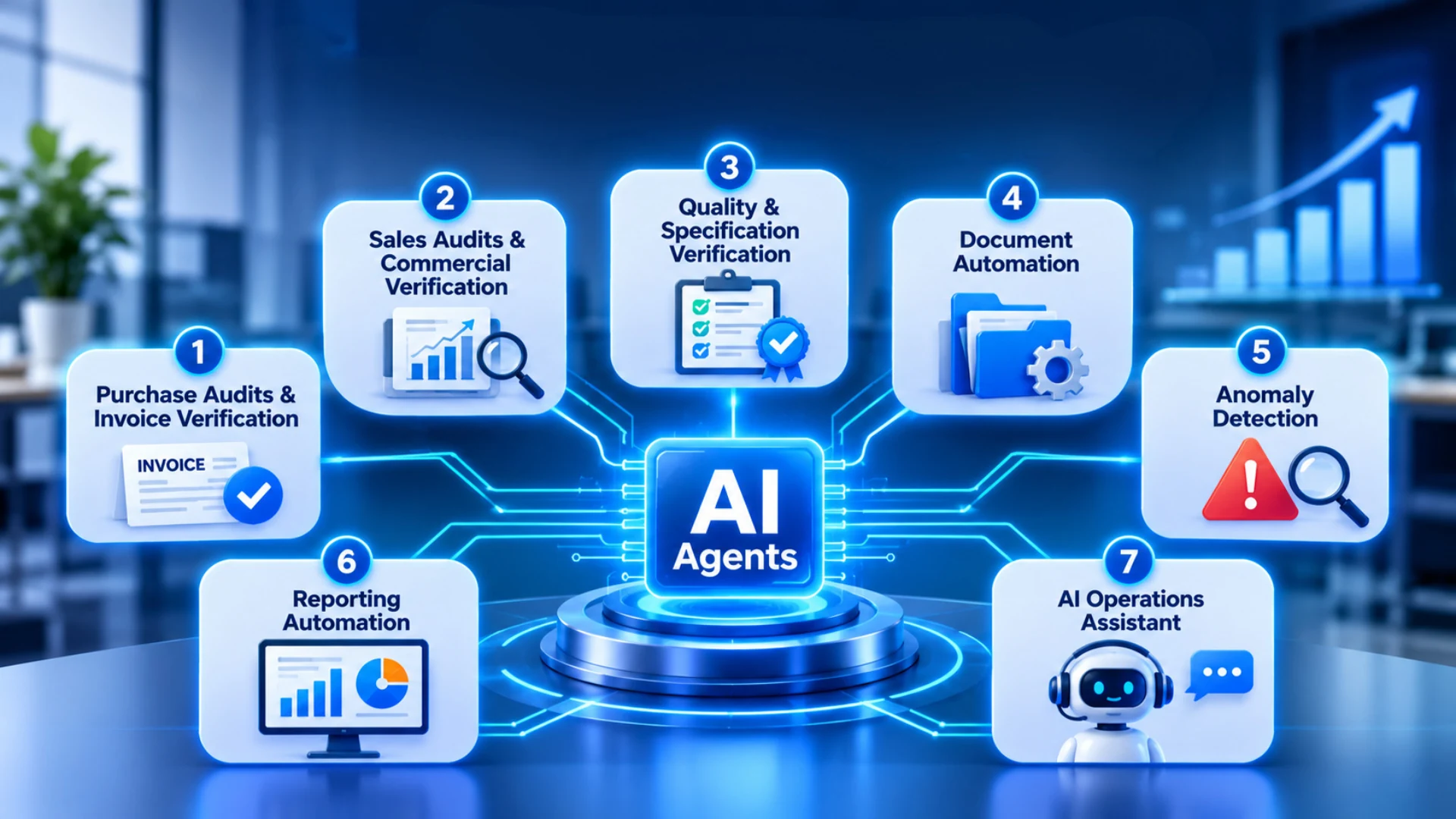
•1. Purchase Audits & Invoice Verification: Automate the multi-way matching of supplier invoices against transport receipts, warehouse weight slips, and purchase orders. AI extracts GSTINs, quantities, and dates, detects duplicate billings, and highlights compliance anomalies.
•2. Sales Audits & Commercial Verification: Compare outgoing sales invoices against approved customer orders and ERP records. Detect unauthorized rate changes, quantity variances, unapproved discounts, and incomplete dispatch tracking.
•3. Quality & Specification Verification: Cross-check customer-approved specifications against manufacturer quality inspection certificates. Verify product grades, coatings, chemical composition, tensile strength, and heat numbers automatically.
•4. Document Automation: Replace manual data entry with intelligent document ingestion. Extract data, validate against reference files, flag missing fields, and build a fully searchable digital audit trail.
•5. Anomaly Detection: Real-time AI analysis categorizes audit items into Match, Partial Match, Mismatch, and Critical Exception—providing clear explanations and recommended approval actions.
•6. Reporting Automation: Consolidate fragmented departmental data into live operations dashboards tracking audit throughput, supplier reliability, and workflow bottlenecks.
•7. AI Operations Assistant: Enable teams to query live operations data using natural language, answering questions about pending audits, recurring supplier issues, and flagged invoices instantly.
The 7 core business processes best automated with AI agents to eliminate manual operations bottlenecks.

Deep Dive: Purchase Audits & Invoice Verification

Purchase verification is often one of the most labor-intensive workflows in wholesale, manufacturing, and supply chain operations. Verifying supplier invoices against physical gate entries, weighbridge slips, and ERP purchase orders manually can take days.

With AI-powered document automation, the workflow is streamlined end-to-end:

•Multi-Source Collection: Ingests supplier invoices alongside transport receipts, warehouse weight tickets, and POs.
•Field Extraction: Parses invoice numbers, GSTINs, transaction dates, weights, rates, and vehicle registration numbers.
•Cross-Document Matching: Validates line-item quantities and rates against contracted purchase terms.
•Anomaly Escalation: Detects duplicates, weight discrepancies, and tax compliance errors, sending flagged items for maker-checker review.

This structured audit workflow protects gross margins and prevents costly overpayments before funds leave the company.
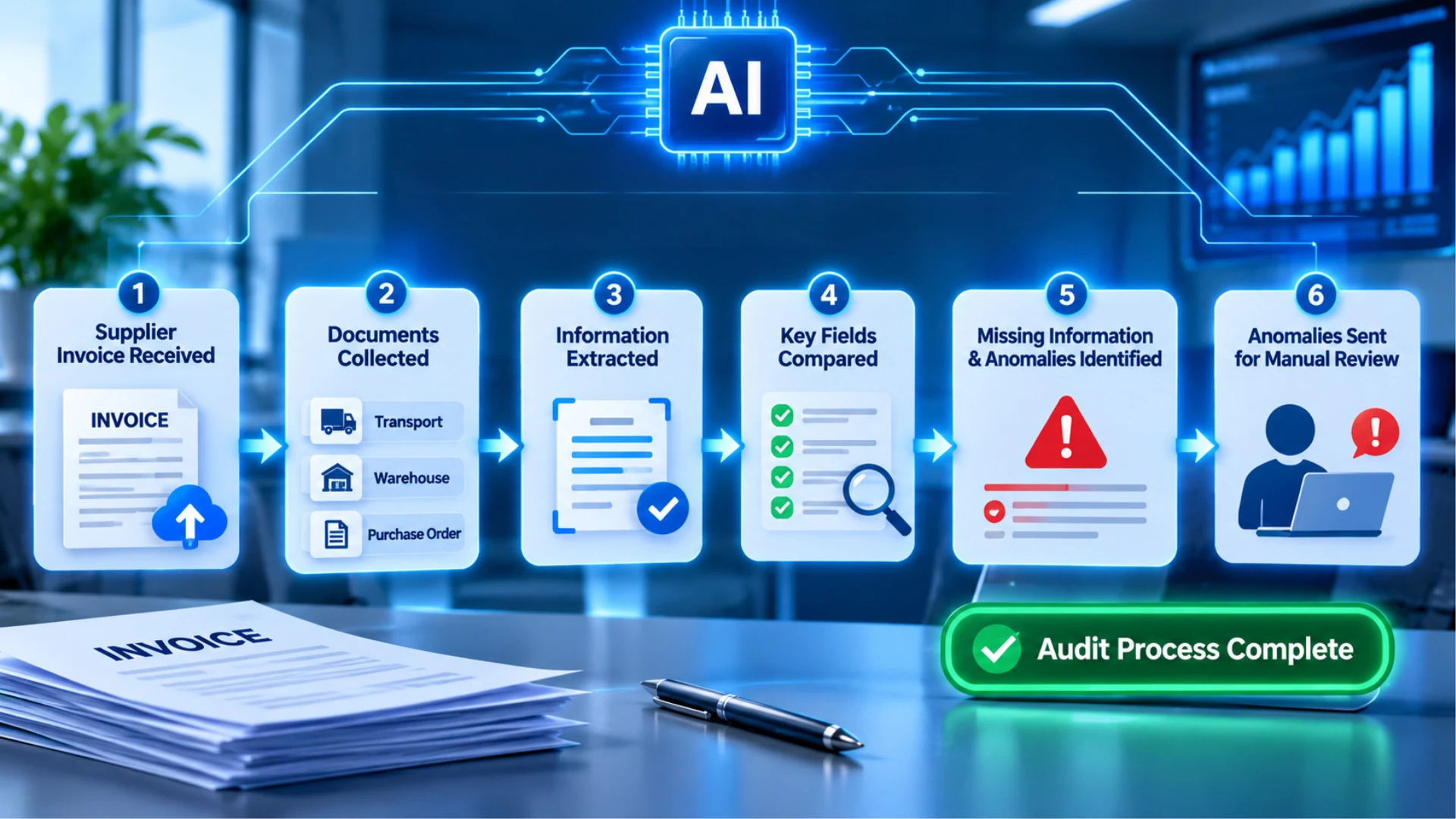
AI document workflow automation comparing supplier invoices, transport receipts, and purchase orders in real time.

Traditional Automation vs. AI-Powered Business Process Automation

While both traditional and AI automation help businesses eliminate repetitive work, their core architectures differ fundamentally:

•Process Logic: Traditional automation follows rigid, predefined if-then rules; AI automation combines rule-based workflows with intelligent contextual analysis.
•Document Processing: Traditional tools require fixed templates and clean forms; AI automation extracts unstructured text, tables, and handwritten data from complex multi-page documents.
•Data Verification: Traditional methods compare specific static fields; AI cross-checks relationships and semantic meaning across disparate documents.
•Anomaly Management: Traditional tools trigger generic alerts; AI categorizes anomalies by severity (Match, Partial Match, Critical Exception) and explains root causes.
•Decision Support: Traditional setups provide binary status updates; AI delivers contextual insights and actionable approval recommendations.
•Operations Reporting: Traditional reporting relies on manually configured exports; AI provides real-time trend analysis and predictive operations intelligence.
•Human Touchpoint: Traditional automation frequently stalls requiring manual intervention; AI confines human effort to high-value anomaly resolution and critical business decisions.

Most modern enterprises benefit from combining both: using traditional rules for predictable handoffs, and AI agents for complex document verification and contextual decision support.
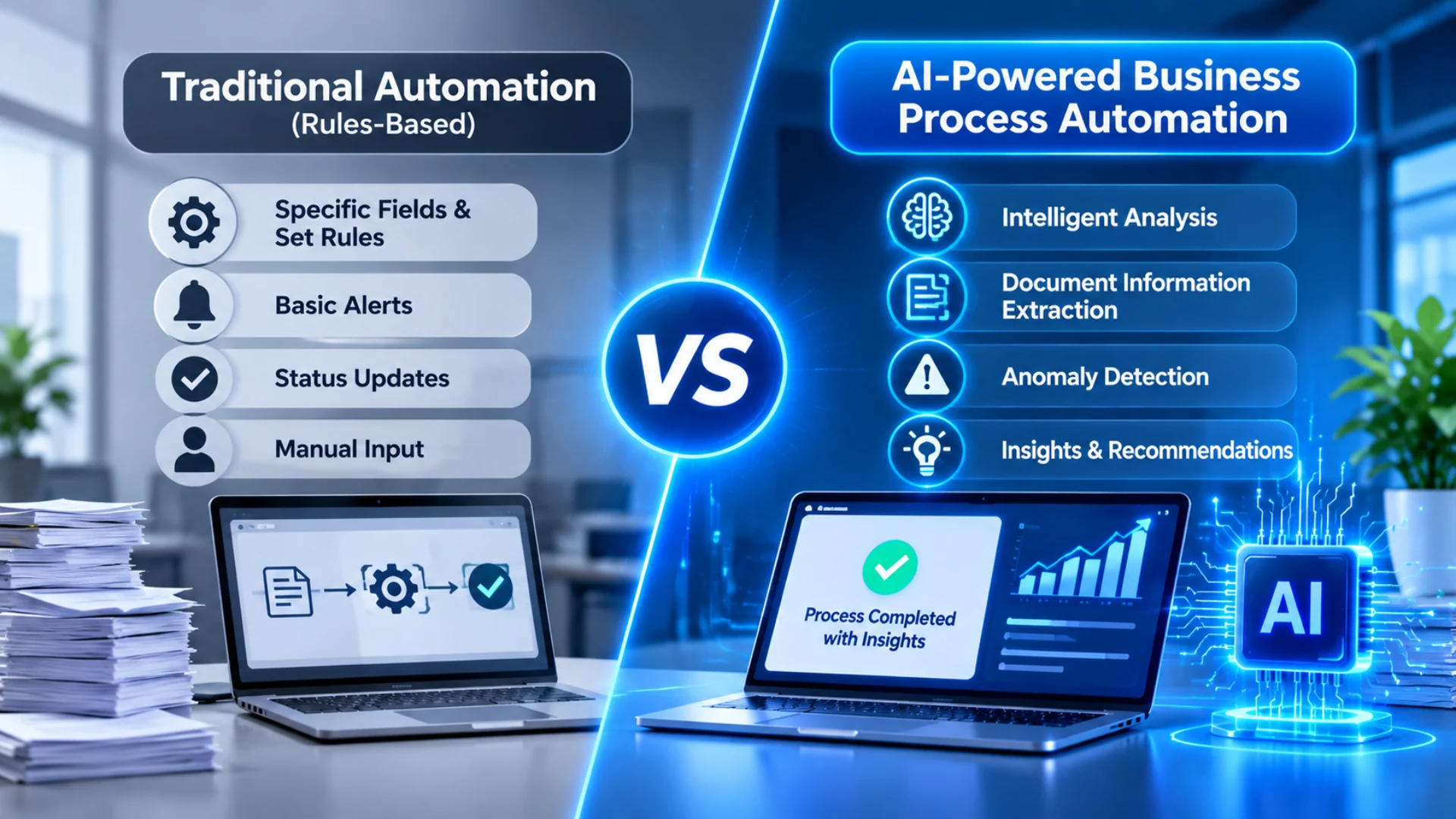
Comparison of rule-based traditional automation versus contextual AI-powered business process automation.

How to Implement Business Process Automation Successfully

Attempting to automate an entire enterprise at once introduces unnecessary complexity. Successful organizations follow a phased, high-impact implementation framework:

•1. Identify Repetitive Bottlenecks: Target workflows that consume excessive administrative hours, require manual data entry, or frequently stall in reconciliation.
•2. Map Information Flows: Trace how documents move between procurement, finance, warehouse, and sales teams. Pinpoint who provides documents, who verifies accuracy, and who approves exceptions.
•3. Select Integrated Automation Tools: Choose platforms that offer native ERP connectivity, intelligent OCR/LLM extraction, configurable maker-checker approvals, and tamper-proof audit trails.
•4. Start With One High-Impact Workflow: Pilot a focused high-volume process—such as supplier invoice verification—and establish baseline metrics for processing time, error rates, and approval velocity.
•5. Scale to Connected Workflows: Once the pilot workflow is stabilized, expand automation into sales audits, quality certification verification, and cross-departmental operations dashboards.

How ScalePods Operations Pod Transforms Enterprise Operations

At ScalePods, we designed the Operations Pod to replace manual paperwork with autonomous, ERP-connected intelligence. Instead of manually cross-checking documents, Operations Pod establishes a unified operational control center:

•Purchase Audit Automation: Ingests supplier invoices, warehouse receipts, and transport bills to automatically verify GSTINs, vehicle numbers, quantities, and pricing.
•Intelligent Sales Audit: Matches sales invoices against customer orders and ERP entries to eliminate unauthorized price overrides, unbilled quantities, and dispatch delays.
•AI Quality Verification: Cross-references customer specifications with mill quality certificates to ensure product grade, chemical composition, and packaging standards match 100%.
•Audit Intelligence: Automatically calculates severity scores (Match, Partial Match, Mismatch, Critical Exception) and generates root-cause analyses with approval recommendations.
•Central Operations Dashboard: Unifies audit volumes, approval turnaround times, supplier variance trends, and operational bottlenecks into executive-level views.
•AI Operations Assistant: Allows operations leaders and auditors to query live operational data using natural language, diagnosing bottlenecks in seconds.

ScalePods Operations Pod delivers proven operational benchmarks:

•100% Documents Cross-Checked: Complete audit coverage with zero manual sampling.
•90% Faster Verification: Accelerating order-to-invoice processing from days to minutes.
•0% Product Non-Compliance: Eliminating specification mismatches before shipment.

Ready to eliminate manual operational bottlenecks? Explore the ScalePods Operations Pod or book an operations strategy audit with our automation specialists.

ScalePods

Build a sales system that works even when your team is offline

Smarter workflows. Better conversations.

FAQs About AI SDR Automation

Business process automation uses technology and artificial intelligence to automate repetitive operational workflows—including document ingestion, multi-way invoice verification, cross-departmental approvals, and executive reporting—with minimal manual intervention.